
Abstract
Small molecule contaminants pose a significant threat to the environment and human health. While regulations are in place for allowed limits in many countries, detection and remediation of contaminants in more resource-limited settings and everyday environmental sources remains a challenge. Functional nucleic acids, including aptamers and DNA enzymes, have emerged as powerful options for addressing this challenge due to their ability to non-covalently interact with small molecule targets. The goal of this perspective is to outline recent efforts toward the selection of aptamers for small molecules and describe their subsequent implementation for environmental applications. Finally, we provide an outlook that addresses barriers that hinder these technologies from being widely adopted in field friendly settings and propose a path forward toward addressing these challenges.
1. Introduction
Environmental contaminants are potentially hazardous chemicals, microorganisms, or other materials that negatively impact the ecosystem or human health.1,2 Human exposure most often occurs through environmental media such as food, water, surrounding air, or consumer products.2,3 While robust processes exist for detecting and removing large contaminants such as bacteria and fungi,4–9 small molecule contaminants (<1 kDa) are harder to mitigate due to their size, diversity, and limited epitopes. Methods that address these challenges are needed because small molecule contaminants are abundant in environmental media. For example, a 2019 study estimated that 80% of grains are contaminated with naturally occurring mycotoxins.10 This percentage is much higher than previously reported due to improvements in detection limits,10 and this example highlights the need for more accurate monitoring of small molecule contaminants. Further, the number of novel contaminants is expected to drastically increase because of large-scale industry practices that are implemented to meet modern day cultural demands.1 A prominent example is organophosphate pesticides, which revolutionized the agricultural industry, but have led to cases of acute human poisoning and long-term health effects due to their persistence in soil, water, air, and food.11–14 Similarly, factory processes represent the major source of water and soil contamination due to toxic waste dumping practices.15 One example is bisphenol A, which is used in the manufacturing of plastics, and is a commonly reported water contaminant.16,17 Further, increased levels of metals such as lead, mercury, and cadmium from these practices have been shown to persist and bioaccumulate, leading to cases of metal poisoning worldwide.18–20
Environmental contaminants cause many human diseases, highlighting the need for rigorous characterization to reduce potential health risks. Global agencies have set guidelines that include parameters such as tolerable daily intake levels to benchmark the maximum amount of an environmental contaminant that is considered safe.21 However, environmental contaminants present in media below established limits can still trigger low dose effects. Recent efforts aimed at designing adaptable methods for direct detection of contaminants in environmental media present a promising new avenue for risk assessment.22,23 Biosensors offer an alternative to traditional detection methods and have gained traction in for a wide range of small molecule detection applications, especially when they obviate the need for expensive equipment such as high-performance liquid chromatography.24,25 To meet field deployable criteria, biosensors must be cost-effective, portable, reproducible, and easy to use.26,27 Additionally, simple field-deployable devices must still have the necessary sensitivity to detect low concentrations of small molecules. Perhaps the most widely known type of biosensor employed for small molecule contaminant monitoring is enzyme-linked immunosorbent assay (ELISA), which utilizes antibodies that bind to the small molecule target and are fused to a reporter enzyme to provide a readable output.28,29 While widely used, ELISA has several disadvantages due to the high batch-to-batch variation in antibody production and cold storage conditions required for stability. Addressing these challenges holds significant promise to advance field friendly molecular recognition-based biosensors.
Beyond biomonitoring, methods are needed to sequester and eliminate environmental contaminants from water sources in order to minimize human exposure. This is especially important given that small molecule environmental contaminants can bioaccumulate in environmental media.16 For instance, many water soluble contaminants end up lakes and streams, where they can further accumulate in fish and other wildlife.30–32 Common decontamination techniques include centrifugation, coagulation, chlorination, photochemical inactivation and the use of membrane systems with varying pore sizes.33 However, these physical or chemical treatments require high amounts of energy, machinery, and complex processes,34 making them poorly suited for the removal of small molecule contaminants in resource limited settings.35 Thus, the development of new field friendly approaches to detection and sequestration of small molecule contaminants have potential to significantly address human and environmental health.
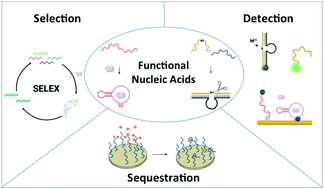
In this perspective, we highlight recent advances in nucleic acids chemistry that could address the aforementioned challenges by enabling new technologies for detection and sequestration of small molecule contaminants (Table 1). Specifically, we will focus on functional DNAs that exhibit activities beyond the canonical role of DNA in storing genetic information, such as recognizing small molecules through non-covalent interactions.36–38 Nucleic acids are inherently field friendly because they are cost-effective to produce, stable to a wide range of conditions, and can be easily functionalized for use in sensors and other platforms. Encouragingly, functional DNAs such as aptamers have already been reported for a variety of natural and synthetic environmental contaminants.24,25 Below, we describe recent efforts to develop and deploy functional DNAs for the detection and sequestration of small molecule contaminants. We highlight key challenges that are encountered and advances in nucleic acid technology that could address these gaps and enable increasingly rapid response to newly emerging environmental threats.